
There’s a particular look people get on the first bite: eyes widen slightly, and they go silent for a second or two, the way people do when something turns out even better than they expected.
Soft gives way to chewy. Chewy gives way to something delicate at the centre, sweet without being sharp about it. Most people pause before reaching for a second piece, not because they’re unsure, but because they want to properly enjoy this one first. What is Mochi?
That reaction is the whole reason Mochi exists on South African shelves. The Master first came across it in an Asian dessert shop, the kind of unplanned discovery that happens when you’re travelling with no particular agenda except paying attention. One bite in, it was obvious this wasn’t going to be a passing curiosity. It was going home with him.
What is Mochi, actually?
Mochi is made from glutinous rice, and it’s been part of dessert tables across Asia for generations. The name often causes more confusion than it should. Glutinous refers to the rice’s naturally sticky texture when cooked, not to gluten. There isn’t any gluten in it at all. It’s simply rice, pounded and worked until it turns soft, stretchy, and completely unlike anything made from wheat flour.
That texture is the entire point. Each piece is soft and pliable on the outside, carrying its flavour all the way through rather than sitting on top of it the way icing sits on cake. It’s a dessert built on texture first, sweetness second, which is exactly why it reads as unfamiliar to a palate raised on chocolate bars and biscuits. Nothing about it is trying to be the loudest thing in the room. It just asks you to slow down and actually taste it.
Seven flavours, one shared reaction
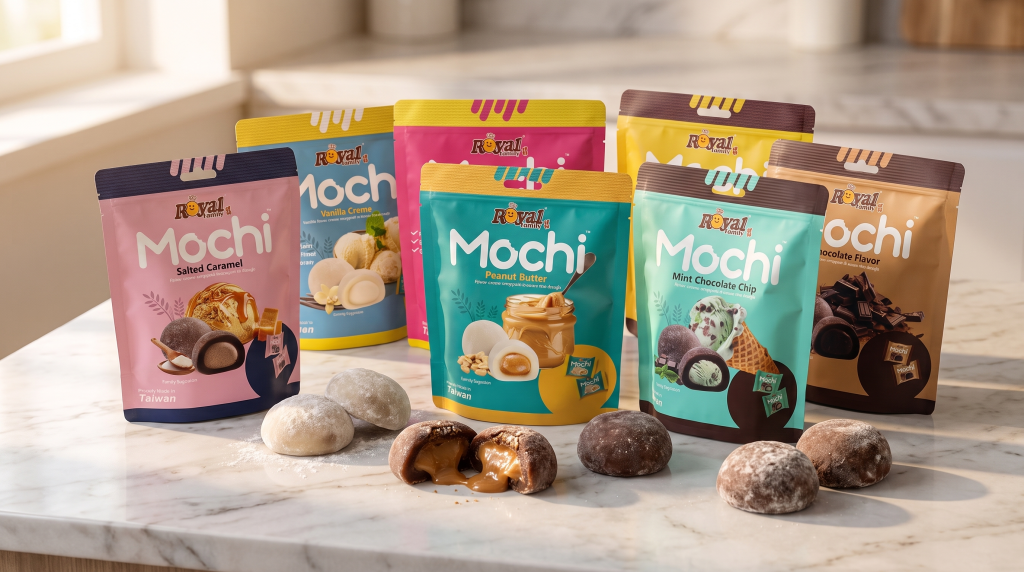
Our Mochi is available in seven flavours: Chocolate, Mint Chocolate Chip, Peanut Butter, Salted Caramel, Strawberry Cheesecake, Tiramisu and Crème, and Vanilla, with twelve pieces in every pack. That range matters more than it might first appear. It means there’s a genuine reason to work through the whole lineup rather than settling on one and never looking further, and it means a single pack can cover a few different moods without anyone needing to compromise.
Made in Taiwan and imported for a South African audience that’s increasingly curious about food from beyond its own borders, our Mochi doesn’t ask anyone to become an expert in Asian desserts before trying it. It only asks for one open-minded bite. The rest tends to take care of itself.
Why it doesn’t compete with traditional sweets
It would be easy to position mochi as a replacement for fudge, or chocolate, or any of the sweets South Africans already know well. That would miss what makes it interesting. Mochi isn’t trying to out-sweet anything on the shelf next to it. It occupies a different space entirely. It’s delicate where most sweets are rich and textural where most are simply sugary.
That’s precisely why it works so well as a shared discovery rather than a solo treat. A bag of Mochi in the middle of the table, passed around after dinner or opened halfway through a slow Sunday afternoon, turns into its own event. Everyone tries a flavour. Everyone has an opinion. Someone always goes back for Salted Caramel, and someone else finishes the Strawberry Cheesecake before anyone notices it’s gone.
Where it actually fits into a week
Mochi doesn’t need a special occasion to make sense, which is part of what makes it easy to keep around. It works after a weeknight dinner when something sweet is wanted, but nobody’s in the mood for anything heavy. It works as the thing you put out when friends come over, and you want the evening to feel like it was worth the effort. It works, too, as a gift for someone who already has every chocolate box and biscuit tin covered and would genuinely be surprised by something new.
A discovery worth making at home
Good discoveries rarely need a big occasion. Most of the best ones happen on an ordinary evening, when someone sets something unfamiliar on the table, and everyone leans in a little closer than they expected. That’s the role Mochi is created for. Not only a special-occasion dessert, but a small, regular reminder that there’s more out there worth trying than what’s already familiar.
You don’t really explain mochi to someone new to it. You just hand them a piece and watch their face while they work it out for themselves.
FAQ Section
1. What is mochi made of?
Mochi is made from glutinous rice, which becomes soft and chewy once it’s cooked and worked. It has nothing to do with wheat.
2. Does mochi contain gluten?
No. “Glutinous” describes the rice’s sticky texture, not gluten content. The Master’s Mochi brand, Royal Family, does not contain gluten from wheat.
3. What flavours does our Mochi come in?
Our Mochi is available in seven flavours: Chocolate, Mint Chocolate Chip, Peanut Butter, Salted Caramel, Strawberry Cheesecake, Tiramisu and Crème, and Vanilla.
4. How many pieces are in a pack of Royal Mochi?
Each pack contains twelve pieces, enough for a household to share or for one person to work through a few flavours at a time.
5. Where is Royal Mochi made?
Royal Mochi is made in Taiwan and brought to South Africa as part of The Master’s range of internationally sourced food discoveries.